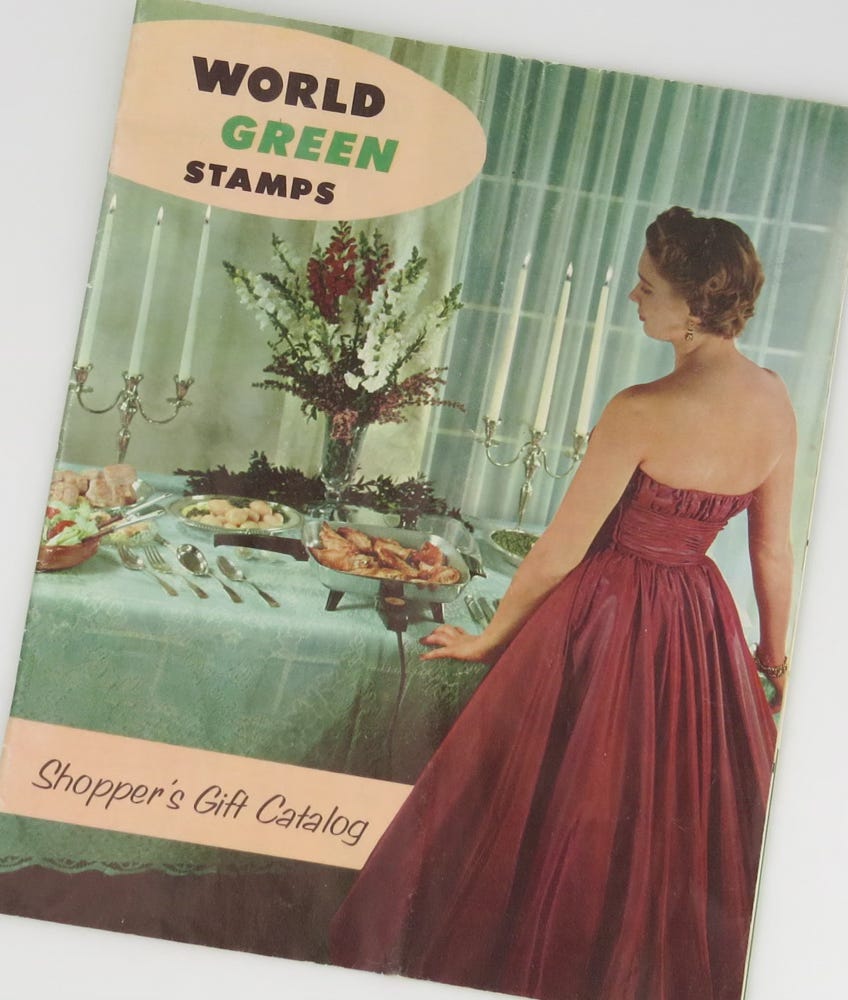
Trading Stamps
Perfect for National Retro Day

National Retro Day falls on February 27. Merriam-Webster Dictionary defines “retro” as “fashionably nostalgic or old-fashioned.” First used in 1972, the term describes reviving, embracing the styles or fashions of the past and traces the first use of the word to 1972.
Another box of estate sale paper prompted a flit down memory lane. Pages of stamps and partially filled booklets reminded me of late winter afternoons when Mother would retrieve a battered envelope from the kitchen junk drawer and sit us down to sort through all the trading stamps she had collected throughout the year.
What could be more retro than trading stamps?
In an excellent overview of trading stamp history, Jeff Lonto suggests “For the most part trading stamps have been relegated to warm, fuzzy nostalgia, a mere footnote in history but they were a far bigger factor in American culture, marketing, the economy and even politics than most likely realize.”
When we sat down to fill “savings” booklets, a rare mood of concentration filled our boisterous little souls as we sorted through the collection of trading stamps. Even Christmas morning couldn’t slake the anticipation of exchanging all those stamps for redemption center sugar plums, the things we could get for “free” once we pasted up all those little stamps.
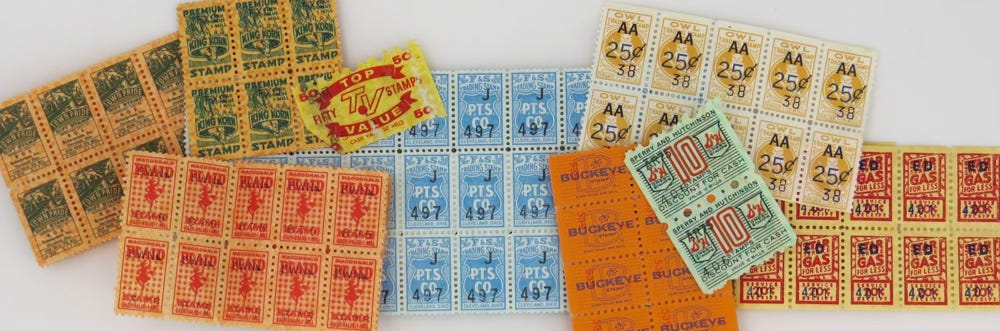
Trading stamps were first introduced in 1891 by a Wisconsin grocery store that aimed to increase customer loyalty and repeat business. A few years later, in 1896, Sperry and Hutchinson Company became the first nationwide distributor of trading stamps, issuing S & H Green Stamps to retailers. (While on our many cross-country camping trips, I recall Mother asking Pop to buy gas from stations that offered S & H Green Stamps.) Dozens of more localized stamp companies sprang up, including Top Value, Plaid, Buckeye, and King Korn. The goal was always the same – to increase customer loyalty with stamps as premiums toward redeeming for additional goods.
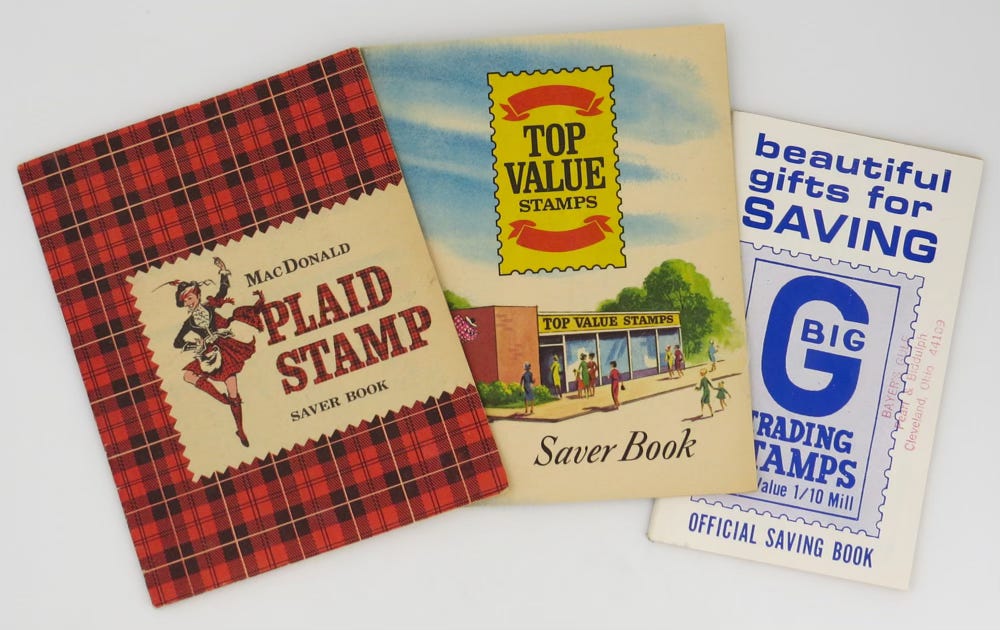
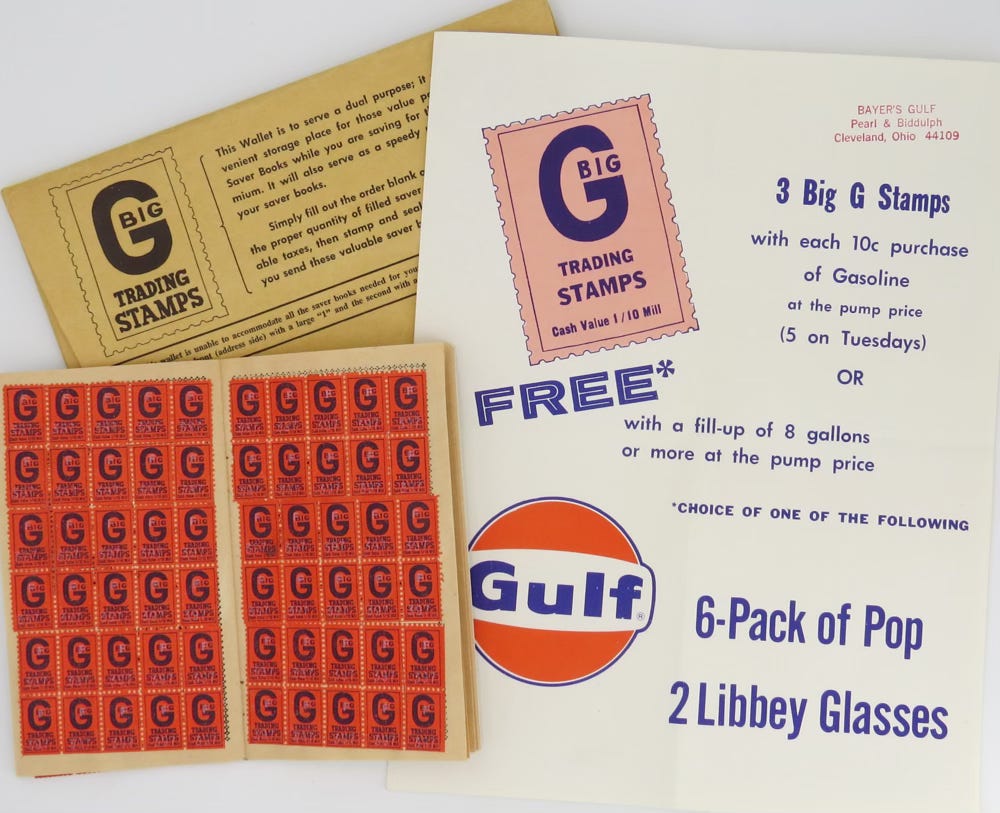
Trading stamps had no true value for anything other than use at redemption centers. The biggest distributors of stamps were grocery stores, where a shopper would receive a stamp for every 10-cents spent. When she had accumulated 1200 stamps, she then pasted those into savings booklets and used the booklets as an exchange for goods offered by the redemption center. Even as trading stamps were slipping out of use in the mid-1960s, Mr. Lonto reports by 1966, “83 percent of the nation’s 58 million households were still saving stamps, with 85 percent of women and 80 percent of men saving them.”
For my family, Top Value Stamps, offered by Kroger and Food Town, were the favorites. The local A & P store used S&H Green Stamps.
An excursion to the Top Value redemption store at Southland Shopping Center was a special treat. All our licking and pasting was rewarded by a large showroom with sparkling glass shelves filled with all kinds of useful treasures.
As I recall, some of our camping gear was acquired with trading stamps. A Coleman stove that came in handy for cocoa on chilly mornings at high elevations, or soup for lunch when we camped in northern Michigan while hunting morels (6 booklets). Those meals were served up in Olympian Therm-O-Ware mugs and bowls that came in enough colors, we each had our own coordinated set (with a wicker picnic basket, 2 booklets). Coleman sleeping bags lined with flannel (5 booklets); although not water-proof, certainly serviceable enough.
Had we been more ambitious, and our household needs not so immediate, we might have saved up enough stamps to trade for a 21-foot Airstream travel trailer (starting at 1495 booklets).
I still have an electric 8-cup percolator that Mom acquired at the redemption center; more than once, that now vintage chrome coffee pot has come in handy (3-1/4 booklets). There’s even a textile connection with trading stamps – my first set of print bedsheets, pretty and luxurious to any 10-year-old, was purchased with 3 booklets of stamps. And if I recall, those sheets lasted for about 20 years!
Quality merchandise was part of the appeal of trading stamps – the merchandise wasn’t really free, but it stood up to hard use and lasted a long time. Sam Moore reminisced in Farm and Dairy, “As I recall, the stuff offered in the catalogs, especially from the S&H Company were first-rate, quality goods.” Trading stamp companies purchased wholesale from manufacturers in such volume, some of the savings could be passed on to consumers. So, trading stamps were economical, helping the family acquire items that normally might have been beyond family budget.
Trading stamp catalogues provide a romping exercise for the nostalgia muscles! Those old catalogues are a reliable source for dating items that are hot on the vintage market. Thumbing through a 1963 catalogue, I see on offer Corningware, Melmac, Samsonite. Moreover, I see Bell and Howell photo equipment favored by my Dad and Pyrex nesting bowls that were used in kitchens across the extended family. At estate sales, I watch in wonder as millennial dealers snatch up Libbey glassware originally offered as trading stamp premiums.
From the very beginning of the craze, trading stamps were not universally loved. High-minded people poo-pooed trading stamps as low-class (that segment of society whose household budgets weren’t stretched in every direction). Non-participating stores blasted the promotion as unfair, a scheme to steal business by convincing shoppers they could get something for nothing. In a 1916 Supreme Court ruling, one Justice wrote that trading stamps were “an appeal to stupidity.” I wonder what his wife thought.
The fervor of collecting and redeeming trading stamps has been replaced by frequent-flyer points and cash-back credit cards. But savvy collectors owe a debt to trading stamp companies for introducing mid-century housewares to a broad audience.
To close this little stroll down Retro Lane, let’s read a poem about trading stamps, written in 1963 by Judy Schoenstein for McCall’s magazine:
A Mother’s Stamp Plan

Today in the grocery, I realized
The way to make my kids civilized.
From now on, I’ll reward the camps
Not with goodies but trading stamps.

Five stamps for putting their toys away.
Ten for not drawing blood all day.
Fifteen if I can finish one call
Without having to cry, “Keep that stuff off the wall!”

Ten for not wiping their mouths on their shirts
Or not using the rug to mount samples of dirts.
And twenty-five stamps for a meal where I’m able
To find more food on than under the table.

And so where I’ve always failed with a spanking,
Perhaps I’ll succeed with this new type of banking.
And perhaps even teach the kids lessons numerical
That are based on the time that they don’t get hysterical.

Of course, please don’t think that my kids are extreme
Just because I’ve been pushed to this desperate scheme.
A mother must treasure the children God sent her.
She can’t trade them at the redemption center.